




If you’re benchmarking European production locations, Bulgaria’s industrial production is one of the most practical “reality checks” you can use, because it captures how factories are performing right now, not just what investment brochures promise.
The latest official data releases might show a soft 2025 headline, but they also point to resilient manufacturing and standout performance in select sub-sectors, especially electrical equipment and electronics-adjacent production. For OEM decision-makers, this combination of cycle-driven headroom plus clear momentum potential is exactly what creates a nearshoring advantage when you execute with the right EMS partner.
What do the IPI and utilisation numbers mean for OEMs?
Industrial Production Index
The IPI measures short-term changes in output across industries (such as mining, manufacturing, and energy). It’s a useful lead indicator for OEMs because it tends to move with demand, export orders, and capacity pressure—factors that show up quickly in lead times, responsiveness, and change-control bandwidth.
As of December 2025, Bulgaria’s IPI was up 0.3% month-on-month but down 6.7% year-on-year. Manufacturing specifically was up 0.7% MoM and down 1.4% YoY—a notably less severe decrease than the overall industry drop.
For OEMs, the practical implication is straightforward: when manufacturing is down only -1.4% YoY while the overall IPI is down -6.7% YoY, you’re looking at an industrial base where core production remains comparatively resilient, even while the overall figure is pulled down by other segments.
This matters because your production risk is rarely tied to “industry in general”, but to whether manufacturing partners can sustain predictable replenishment, disciplined engineering change, and stable yields during transfer and ramp.
The same release shows much larger annual falls in mining (-22.3%) and energy supply (-14.1%). For OEM sourcing decisions, that distinction clarifies that the “softening” is not a uniform stop-start in manufacturing. It’s managed variability across the wider industrial mix.
When you plan your programme around controlled scale-up, a softer demand cycle can be an advantage because it creates buyer power in line time, supplier attention, and NPI focus.
Capacity utilisation
Bulgaria’s National Statistical Institute Key Indicators report showed that capacity utilisation stood at 75.4% in October 2025. This signals balanced utilisation to OEMs, indicating real industrial activity (so you’re not building on a hollow ecosystem), while leaving visible capacity for new programmes that need a ramp window.
For programme leaders, this is where the operational insight becomes actionable. At 75.4% utilisation, you can typically structure capacity commitments that support disciplined NPI without forcing uncontrolled overtime or rushed hiring. This is a way to protect quality gating during early builds, particularly when your product has test-intensive steps or high-mix variants.
It’s worth mentioning that the NSI’s reports also flagged a sharp -10.4% YoY IPI reading in April 2025 (calendar-adjusted), including manufacturing at -7.0% YoY. This is not necessarily a reason to avoid Bulgaria, but a reminder to scenario-test your supply plan for cyclicality.
The most robust sourcing decisions treat variability as a design input with dual sourcing, inventory buffers for long-tail components, and validated alternates; in this sense, flexible capacity agreements are not “nice to have”, but how you operationalise resilience.

Why Bulgaria’s trade mix reduces friction for Europe-facing builds
For OEMs, the most decision-relevant Bulgaria manufacturing statistics are those that show what Bulgaria makes for Europe and how well established its logistics and compliance routines are.
Exports
Exports anchor the story. NSI data for 2024 showed exports to EU countries of around BGN 55.9bn (~€28.6bn), up 1.5% year-on-year, with Germany, Romania, Italy, Greece, France, and Poland accounting for 67.0% of exports to the EU.
This is a practical proxy for EU-readiness: when a country’s export engine is concentrated into core EU partners at that scale, the manufacturing ecosystem is typically fluent in EU customer expectations and cross-border fulfilment routines.
The real benefit is operational. Smoother documentation, established trade flows, and a higher probability that suppliers are already working to European traceability and change-control norms.
Bulgaria also exported BGN 30.4bn (~€15.7bn) to non-EU countries in 2024, with Turkey, the US, Serbia, North Macedonia, China, the UK, and Egypt accounting for 50.2% of non-EU exports.
For OEMs, the point is not “EU only” versus “non-EU.” It’s that the EU export orientation is strong enough to support predictable replenishment into Europe, while the broader export spread indicates supply-chain familiarity across multiple customer requirement sets.
Sub-sector momentum that matters for electronics programmes
When qualifying an EMS location, the most useful industrial signals are those that correlate with your build reality: PCBA discipline, test intensity, high-mix assembly, and the ability to industrialise reliably.
Electronics and electrical equipment
Even in a soft headline month, electronics-adjacent manufacturing can tell a different story.
In December 2025, the NSI reported that electrical equipment manufacturing was up 60.3% YoY (within manufacturing). Month-on-month, computer, electronic and optical products rose 14.6%, and electrical equipment rose 19.1%.
For OEM programmes, this is a proxy for capability. Strong movement in electrical equipment and electronics-adjacent categories indicates an active ecosystem around electrical assemblies, electronics production steps, and test-intensive work.
In practical terms, this shows that local suppliers and labour markets are familiar with the routines your programme depends on: controlled build processes, functional test coverage, failure analysis loops, and the day-to-day discipline required for high-mix production.
If your product mix includes industrial controls, sensors, power electronics, or high-mix box builds, these sub-sector signals justify deeper supplier qualification now while the broader cycle creates headroom. That is how you turn “softening” into a nearshoring advantage, by qualifying early, locking in the right operating model, and ramping in a controlled way.
Automotive and precision engineering
Bulgaria’s automotive footprint often shows up less as complete vehicles and more as components, harnessing, mechatronics, machining, and tier supply.
In December 2025, the NSI recorded that the manufacture of motor vehicles, trailers, and semi-trailers was at 6.6% — the highest for the year. In the same month, however, the NSI also flagged annual declines in some manufacturing categories; for example, “other transport equipment” was among the larger annual declines cited.
For OEMs, this mix is a familiar pattern in Europe-facing manufacturing. There is active capability and cyclicality. The best response is not avoidance but mitigation that is built into the programme plan.
If European demand cycles soften, you protect schedule and continuity by having dual sourcing options, inventory buffers for long-tail components, validated alternates, and flexible capacity agreements. Those controls keep your ramp stable even when the market is put through its paces.
Medical devices and high-mix manufacturing
For MedTech and regulated products, the key question is rarely “Can the country manufacture?” and almost always “Can the operation sustain controlled change, traceability, validation, and documented quality at speed?”
Bulgaria can be an excellent place for high-mix manufacturing and industrialisation, especially when paired with an EMS partner that brings mature quality systems and disciplined NPI methods. That way, you’re not “building the process” while building the product.
Structurally competitive cost, productivity, and energy
Cost is never just wages. For OEM decisions, you want a combined view of labour, energy inputs, tax simplicity, and currency friction, because these factors determine true landed cost and resilience.
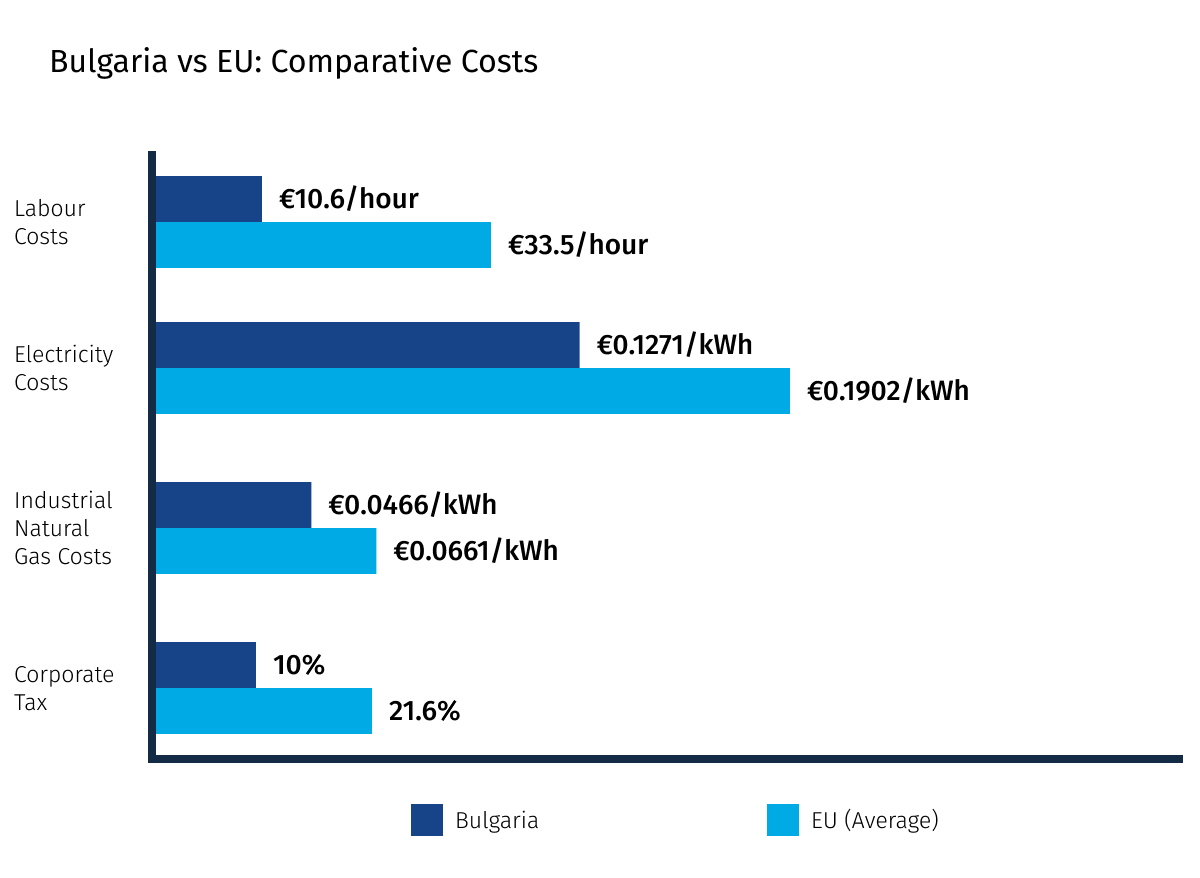
- Labour cost competitiveness: Eurostat’s 2024 comparison of average hourly labour costs shows Bulgaria at €10.6/hour, compared with an EU average of €33.5/hour. This supports a clear nearshoring business case when your product has meaningful direct labour content across PCBA, test, and high-mix assembly. It also creates buyer power in longer programmes where recurring unit economics matter.
- Industrial electricity: Electricity prices for non-household customers in the first half of 2025 ranged from 500–2,000 MWh at €0.1271/kWh (excluding VAT and other recoverable taxes). For comparison, Eurostat’s EU average (medium non-household band) in H1 2025 was €0.1902/kWh. For OEMs with energy-sensitive test profiles or energy-intensive processes, this supports competitiveness while helping stabilise cost variance.
- Industrial natural gas: Eurostat’s non-household (10,000–100,000 GJ) reading for H1 2025 put Bulgaria among the EU’s lowest at €0.0466/kWh versus an EU average of €0.0661/kWh. This reinforces that energy inputs can be a structural advantage, not just a short-term swing factor.
- Corporate tax: Bulgaria’s corporate income tax rate is a flat 10%. For OEMs building long-range business cases, the simplicity is as valuable as the rate: it reduces modelling ambiguity when you are comparing multi-site strategies.
- Currency simplification: Bulgaria has adopted the euro with a fixed conversion rate of 1 euro = 1.95583 lev. For Europe-facing OEM programmes, this reduces currency friction compared with earlier years of BGN-priced operations, supporting cleaner cost modelling, pricing decisions, and contractual simplicity.
Nearshoring advantage and predictable replenishment
Bulgaria’s core location advantage is straightforward: it sits within the EU manufacturing system, with trade flows that support it.
Exports to EU countries reached almost BGN 56bn (~€28.6bn) in 2024, and a concentrated set of EU partners accounted for 67% of those exports. For OEMs, that indicates sustained industrial linkage into core European markets. The operational implication is reduced friction with harmonised product requirements, familiar cross-border fulfilment routines, and the ability to design replenishment cycles that are typically more predictable than long offshore lanes—especially for high-mix products with frequent engineering changes.
In practice, this matters most at the programme level. When change is inevitable (new variants, ECOs, component substitutions), you want a supply chain that can absorb controlled change without adding weeks of delay. EU integration supports that, and the current cycle-driven headroom increases the likelihood of securing attention and capacity during critical early phases.
Turn Bulgaria’s headroom into controlled scale-up
If you’re considering Bulgaria as part of a Europe-facing manufacturing footprint, the practical question is not “Is Bulgaria attractive?” but “how fast can we industrialise—and how safely can we scale—without introducing avoidable programme risk?”
ESCATEC operates an electronic manufacturing facility in Plovdiv, Bulgaria. This site’s capability set includes DfX, industrialisation, PCBA, box build, mechanical assembly, plastic injection moulding, testing, and logistics support; exactly what OEM teams need as they move from prototype to stable volume.
Here is how that maps to the numbers and to your programme realities:
- When the cycle softens, you gain a practical opening to secure capacity and attention: ESCATEC Bulgaria is structured to convert that headroom into disciplined NPI with DfX up front, industrialisation that prevents avoidable yield loss, and quality gating that reduces late surprises.
- When utilisation is balanced, you get an active ecosystem with room for controlled scale-up: ESCATEC’s end-to-end capabilities in Plovdiv mean you can manage PCBA, test, and box build coherently rather than splitting accountability across multiple vendors, which is a common source of avoidable schedule and quality risk.
- When electrical equipment is up, and electronics-adjacent categories rise, you have an external signal of electronics-related momentum: ESCATEC Bulgaria is positioned to support electronics programmes with PCBA, test, and high-mix assembly, supported by industrialisation and DfX to make change controlled rather than disruptive.
- When costs are structurally competitive, you get a location that can support sustained unit economics. ESCATEC’s role is to protect those economics with supply chain execution that includes disciplined sourcing, validated alternatives, and operational controls that keep programmes stable when conditions shift.
- When EU export orientation is strong, you gain EU-ready logistics and compliance routines. ESCATEC Bulgaria adds the day-to-day operational muscle with documentation discipline, traceability expectations, and programme governance that OEM teams depend on.
Leverage ESCATEC's multi-site footprint
ESCATEC’s multi-site European footprint extends beyond Plovdiv to Chomutov (Czech Republic), Lutterworth (United Kingdom), and Heerbrugg (Switzerland), alongside wider global operations; ESCATEC also has over 2,000 employees across locations.
For OEMs, this footprint is a practical risk control. Our multi-site capability supports:
- Faster NPI transfer if constraints appear: when you have shared methods and the ability to re-balance, you can protect delivery without restarting from zero.
- Supply chain resilience through shared qualification and sourcing discipline: shared qualification helps you design alternatives and sourcing strategies that are programme-safe.
- Consistent quality methods when product families span multiple build locations: shared qualifications and quality gating reduce the risk of “site-to-site drift” when you scale.
If you’re tracking Bulgaria industrial production trends and weighing nearshoring options, a focused feasibility discussion will usually tell you quickly whether Bulgaria—and ESCATEC Bulgaria in particular—is the right fit for your product and your ramp plan.
Next steps
If you want to turn Bulgaria’s headroom, EU export orientation, and cost competitiveness into a low-risk, Europe-facing manufacturing plan, book a call with our team now.

FAQs
1. Is Bulgaria's industrial production rising or falling right now?
Official data shows that in December 2025, Bulgaria’s industrial production was down 6.7% YoY, while manufacturing was down 1.4% YoY. The month was slightly positive, suggesting stabilisation within a soft cycle rather than a surge. For OEMs, that is often the most useful moment to act, as softening creates headroom and buyer power for new programmes, while manufacturing remains resilient enough to support disciplined execution.
2. What are Bulgaria’s most important export relationships for manufacturers?
Bulgaria’s exports are strongly EU-linked, with Germany, Romania, Italy, Greece, France and Poland accounting for 67.0% of 2024 exports to the EU. Exports to EU countries were around BGN 55.9bn (~€28.6bn) in 2024. For OEMs, this points to EU-ready fulfilment routines and supplier familiarity with European customer expectations, supporting more predictable replenishment into core EU markets
3. What are manufacturing wages like in Bulgaria?
The NSI reported average gross monthly wages in manufacturing at BGN 2,191 in June 2025 (~€1,120). For OEMs, this supports a structurally lower-cost EU manufacturing base. The practical decision point is to pair this with disciplined programme planning—especially for labour- and test-intensive products—so you can lock in a controlled scale-up plan and protect the unit economics across ramp and steady state. The draft also notes that hourly labour cost rose 12.8% YoY in Q3 2025; for multi-year programmes, modelling this upfront helps keep business cases robust.
4. What are typical investor incentives and tax conditions?
Official investor guidance describes a 10% corporate income tax rate, and Bulgaria has an investor incentives framework administered through the state (project qualification/certification-based support). For OEMs, the pragmatic approach is to screen eligibility early, so you don’t lock in facility layout or capex assumptions before you understand what is realistically supportable.
5. Are industrial energy prices in Bulgaria competitive?
In H1 2025, the NSI reported an electricity cost of €0.1271/kWh, compared with Eurostat’s EU average of €0.1902/kWh. For gas, Eurostat reports Bulgaria at €0.0466/kWh vs an EU average of €0.0661/kWh. This supports structural competitiveness, particularly where test profiles and process steps are energy-sensitive, while still encouraging smart contracting and scenario-tested planning to manage Europe-wide variability


