


Smart energy management has shifted from a differentiator to a baseline market expectation for buildings globally. For OEMs developing building automation and control (BAC) hardware and systems, understanding the leading platforms and products in this space drives smarter design decisions, better integration choices, and stronger product positioning.
What is smart energy management?
Smart energy management systems use sensors, controllers, software, and data analytics to optimise how buildings consume and conserve energy. These systems enhance building automation by dynamically adjusting lighting, HVAC, water usage, and electrical loads based on real-time data, user habits, and environmental factors.
The benefits are significant: reduced energy waste and utility costs, greater regulatory compliance, improved occupant comfort, and seamless integration with IoT and cloud platforms for holistic, portfolio-level performance insights.
Smart energy management systems use sensors, controllers, software, and data analytics to optimise how buildings consume and conserve energy. These systems enhance building automation by dynamically adjusting lighting, HVAC, water usage, and electrical loads based on real-time data, user habits, and environmental factors.
17 proven smart energy management solutions
Here are seventeen commercially proven, globally deployed technologies relevant to BAC product development. For OEMs developing BAC innovations, these products and technologies represent the gold standard in energy management solutions, demonstrating what success in design, integration, and scale-up looks like.
1. Schneider Electric — EcoStruxure™ Building Operation (BEMS)
Formerly known as StruxureWare Building Operation, EcoStruxure™ Building Operation is an enterprise building energy management system that unifies HVAC, lighting, power, and security across large portfolios with built-in analytics and energy KPI dashboards.
The system is BACnet/IP and Modbus native, and integrates seamlessly with field controllers and third-party devices. Notable features include centralised fault detection and diagnostics (FDD), a scalable app ecosystem, and lifecycle performance reporting.
2. Siemens — Desigo CC (integrated building management)
An open, integrated, and unified building management platform, Desigo CC covers energy, HVAC, fire, and security, with integrated energy reporting and demand optimisation tools for complex facilities.
Also BACnet/IP native, it supports OPC UA and Modbus for broad device compatibility across campus deployments. The system's energy dashboards, demand forecasting, and scalable architecture — from single buildings to multi-site campuses — make it a strong option for reducing energy consumption through optimised resource usage based on schedules, occupancy, and weather data.
3. Johnson Controls — Metasys® (BAS/BEMS)
A widely deployed building automation system, Metasys® boasts integrated energy management, FDD, and lifecycle equipment analytics trusted in commercial, healthcare, and campus environments.
Its open BACnet/IP architecture connects field devices, submeters, and enterprise systems, while its AI-assisted FDD, remote monitoring, and proactive equipment lifecycle management support smarter, savvier building management decisions.
4. SkyFoundry — SkySpark (FDD & energy analytics)
Compatible with all data types, SkySpark is a data-driven FDD and analytics platform that detects HVAC and controls faults, quantifies energy impact, and supports continuous commissioning for commercial buildings.
With data enablement at its core, SkySpark integrates with BMS via BACnet, Modbus, and REST APIs, supporting historical data connectors from leading BAS platforms. Its notable features include rule-based and machine learning analytics, proven energy savings documentation, and an extensible third-party app framework.
5. Honeywell — Forge Energy Management (cloud analytics)
Honeywell Forge is a cloud-based IoT analytics and energy management platform that aggregates building data to surface efficiency opportunities, anomalies, and sustainability metrics at portfolio scale.
The system’s range of building products connect to the BMS via REST APIs and standard protocols, including BACnet and Modbus, providing portfolio-level energy benchmarking, anomaly detection, and ESG/sustainability reporting outputs.
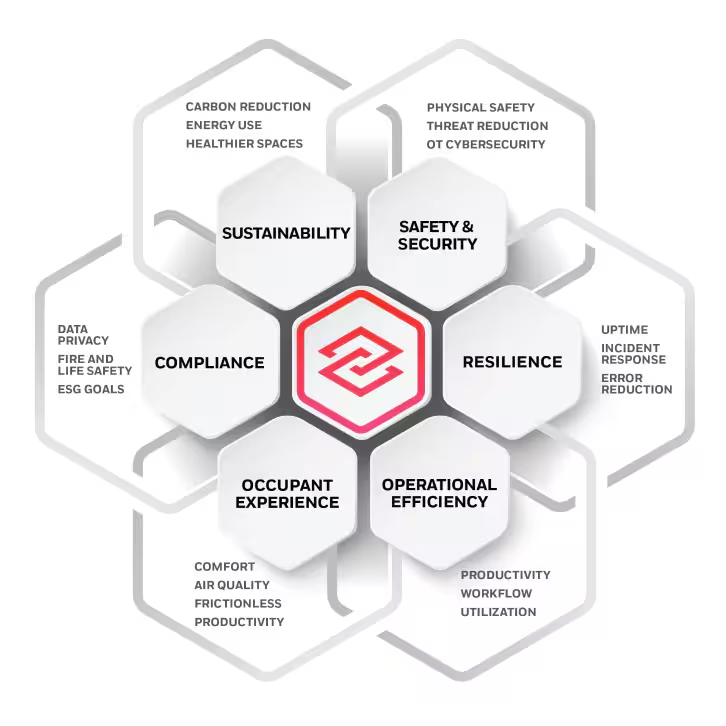
Honeywell's Forge analytics & energy management platform
6. BrainBox AI — Autonomous HVAC Optimisation (AI HVAC)
With a focus on reducing emissions and costs for buildings, BrainBox AI is an AI-powered HVAC optimisation engine that autonomously adjusts setpoints in real time using predictive models, live weather data, and occupancy signals — without the need to replace existing hardware.
BrainBox AI wraps your existing BMS via BACnet/IP as a non-invasive overlay, with no controller replacement required. Its noteworthy benefits include continuous self-learning, peak demand shaving, and independently verified energy reductions of 10–25%.
7. ABB — Ability Energy Manager (submetering and BEMS)
ABB's Ability Energy Manager is an energy monitoring and management platform that provides granular submetering across electrical distribution systems, enabling load analysis, carbon tracking, and waste reduction at circuit level.
The system integrates with ABB smart meters and third-party devices via Modbus, BACnet, and MQTT to monitor and optimise energy consumption. Real-time and historical data dashboards, carbon footprint tracking by building, area, or device, and ISO 50001 energy audit reporting support are all notable features.
8. Tridium — Niagara Framework (integration middleware)
Tridium’s Niagara Framework is the industry's leading open software framework and IoT platform for connecting disparate building systems, including HVAC, lighting, power, and security, over a unified IP network.
The de-facto integration layer for BACnet, Modbus, SNMP, and legacy protocols, Niagara runs on embedded controllers and edge hardware to connect real-time operational data to the people and systems managing smart building workflows.
Niagara’s key features and benefits include device-agnostic connectivity, built-in cybersecurity features, and a large global certified integrator community.
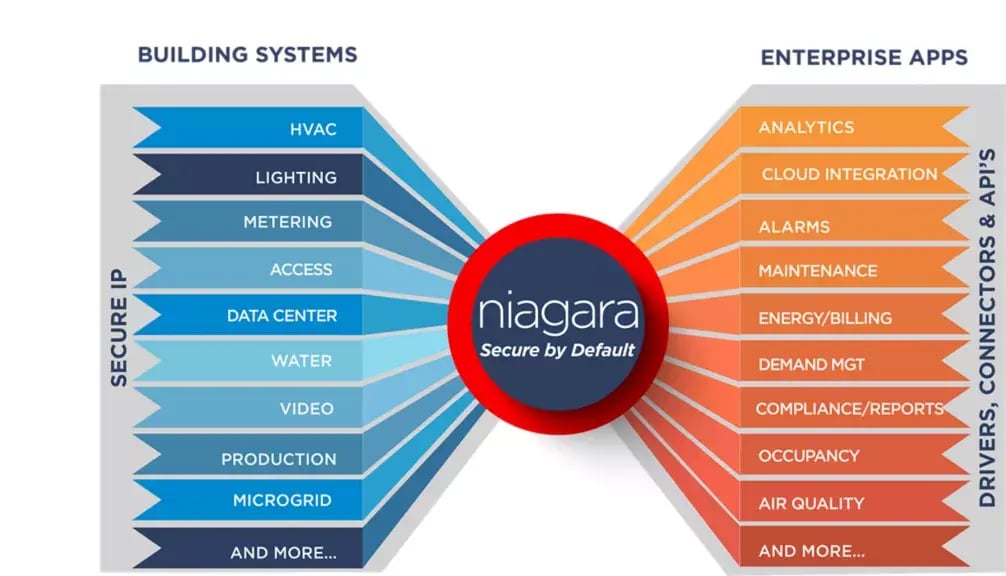
Tridium's open software building management framework & IoT platform, Niagara
9. Eaton — Power Xpert Metering (power quality & submetering)
Eaton's Power Xpert suite of power quality meters and software provides deep visibility into electrical distribution, identifying inefficiencies, power quality events, and billing discrepancies.
Whether your goal is reducing energy costs or improving the reliability of electrical energy to critical operations, each meter connects to your BMS via BACnet/IP and Modbus, and integrates into centralised energy dashboards to provide harmonic distortion analysis, peak demand alerting, and utility billing verification.
10. Danfoss — VLT HVAC Drive FC 102 (Variable Frequency Drive)
Delivering higher reliability and lower total cost of ownership for HVAC systems, Danfoss’ VLT HVAC Drive FC 102 is a variable frequency drive (VFD) purpose-built for HVAC fan and pump applications, that dynamically matches motor speed to actual load demand to eliminate energy waste.
With native BACnet MS/TP and PROFIBUS communication, the drive provides plug-and-play integration with most BMS controllers, ensuring performance efficiency and reliability.
Notable features and benefits include up to 50% energy savings on fan and pump loads, built-in safety functions, and automatic sleep/wake modes.
11. Lutron — Quantum Lighting Control (smart lighting)
A commercial-grade networked lighting control system, Lutron's Quantum Lighting Control integrates daylight harvesting, occupancy sensing, and scene management across large facilities with granular zone control.
As a single platform capable of supporting over 10,000 devices, Quantum integrates with BACnet/IP gateways and interfaces with HVAC and BMS for coordinated, occupancy-based load control. Fixture-level control, energy logging, DALI protocol support, and documented energy reduction per zone are all notable features.
12. Signify — Interact Pro (occupancy analytics & lighting)
Signify's Interact Pro is a cloud-connected lighting management system with integrated occupancy analytics that optimises energy use and supports space utilisation decisions in buildings.
Wireless and easy to retrofit, the system integrates with your BMS via REST API, and its occupancy sensor data feeds into building analytics and HVAC control platforms. It also supports people-counting data, energy dashboards, remote commissioning, and integration with third-party facilities management platforms.
13. Enel X — Demand Response Platform (load flexibility)
An easy, low-effort way to help stabilise the electricity grid during peak demand, Enel X's Demand Response Platform is a demand response and load flexibility service that enables buildings to curtail or shift electrical loads in response to grid signals — reducing utility costs and earning grid incentive payments.
It's compatible with smart meters and directly controllable loads such as HVAC, lighting, and storage, thanks to BMS integration via API or gateway. Automatic curtailment, a revenue-generating demand response programme, and ESG performance reporting make the platform particularly compelling.
14. Belimo — Energy Valve (waterside efficiency control)
The Belimo Energy Valve is an intelligent pressure-independent control valve with an integrated power meter that actively measures and limits hydronic coil energy consumption in real time, directly in the valve body.
BACnet MS/TP and Modbus RTU native, the Energy Valve logs coil energy data directly into your BMS without additional sensors or wiring. It also provides a delta-T management function for chiller protection, guaranteed energy limits per coil, and continuous hydronic diagnostics.
15. SolarEdge — Commercial Energy Hub (solar PV + building EMS)
SolarEdge's Commercial Energy Hub is a DC-optimised inverter and energy management platform for commercial solar PV, with smart export control and self-consumption optimisation for large commercial and industrial installations.
Its Modbus TCP interface enables integration with building EMS for solar curtailment and self-consumption optimisation, allowing buildings to generate more energy on-site while maximising cost savings. Notable features include module-level performance monitoring, dynamic grid export limits, and a scalable architecture designed to support broader on-site energy management strategies.
16. ChargePoint — EV Charging Management (EV + building load)
Tenants and employees now expect EV charging stations in the same way they expect outdoor, health, or lifestyle amenities. ChargePoint offers a cloud-managed EV charging network platform with smart load management, scheduling, and energy cost controls designed to integrate EV demand into overall building power budgets.
With an open OCPP protocol, the platform integrates with building EMS for coordinated demand management and peak demand shaving, while providing dynamic load balancing across stations, driver management portals, and sustainability reporting exports.
17. Optimum Energy — OptiCx® (HVAC system optimisation)
OptiCx®, one of Optimum Energy's cloud-based data analytics solutions, optimises the performance of HVAC systems by delivering real-time monitoring and insights. Through a comprehensive view of system operations, a user-friendly interface, and powerful analytics, it enables facility managers to track performance and drive sustainability and performance improvements.
It operates as a non-invasive optimisation overlay that does not replace controllers and easily integrates with existing BMS via BACnet/IP.
How ESCATEC helps BAC OEMs go from idea to scale
These solutions represent significant hardware design, embedded software, and systems integration challenges for OEMs. Bringing a controller, sensor node, energy gateway, or edge computing device to market requires a manufacturing partner who understands the full product lifecycle — from early-stage design through high-volume production.
ESCATEC supports BAC OEMs with:
- Design for manufacturability (DFM): Early design reviews that reduce unit cost and improve yield for controller PCBAs and enclosures.
- NPI and rapid prototyping: Fast-turnaround new product introduction to support iterative BAC hardware development cycles.
- PCBA and box-build assembly: End-to-end manufacturing for embedded IoT devices, communication gateways, and panel-mounted controllers.
- Testing and compliance: Functional test strategy, CE/UL certification support, and environmental qualification for commercial-grade BAC products.
- Supply chain and lifecycle services: Resilient multi-source component procurement and long-term production support across our global manufacturing sites.
Conclusion
Smart energy management has become a baseline market expectation for residential and commercial buildings globally. For OEMs developing BAC hardware and systems, understanding this landscape drives smarter design decisions, better integration choices, and stronger product positioning.
Those with strong, agile manufacturing partnerships will thrive. Whether you're producing a controller, a smart energy gateway, or an edge computing device for HVAC optimisation, the road from R&D to rollout is full of risks and complexities.
ESCATEC partners with BAC OEMs to bridge the gap between innovation and scalable, compliant manufacturing at every stage of the product lifecycle.
Ready to accelerate your next BAC product? Get in touch with our team or download our Smart Building Partnerships guide for free.
Editor's note: This blog was published in July 2025 and has been updated in June 2026 for relevance and accuracy.

FAQs
1. What is the difference between a BEMS and a BMS?
A building management system (BMS) automates and monitors core building systems, including HVAC, lighting, and security. A building energy management system (BEMS) focuses specifically on measuring, analysing, and optimising energy consumption, typically with advanced analytics, reporting, and sustainability dashboards layered on top of BMS data.
2. How do modern BAC solutions integrate with legacy BACnet and Modbus devices?
Most commercial platforms support BACnet/IP and Modbus TCP natively, or provide certified protocol gateways. Middleware frameworks such as Tridium Niagara are widely used to bridge legacy field devices with modern cloud and IP-based energy management systems.
3. How should OEMs approach data security in connected BAC products?
Security must be designed in at the hardware and firmware level. Best practices include encrypted communications (TLS/DTLS), role-based access control, secure boot, over-the-air update integrity, and compliance with frameworks such as IEC 62443. EMS partners with embedded security expertise can integrate these requirements early in the design process, avoiding costly retrofits.
4. How do OEMs choose between vendor-specific and open-protocol BAC platforms?
Open-protocol platforms — those supporting BACnet, Modbus, and MQTT — offer greater long-term interoperability and avoid lock-in, which is generally preferable for hardware OEMs serving diverse customer environments. Vendor-specific platforms may offer deeper feature integration but can constrain customer flexibility. Designing products that support multiple protocols from the outset increases the addressable market significantly.