



A warehouse robot looks simple. A chassis, some wheels, and a lifting deck. What makes it work is the electronics.
Automated guided vehicles (AGVs) and autonomous mobile robots (AMRs) are now the fastest-growing part of warehouse automation, and the numbers show it. The International Federation of Robotics (IFR) counted 102,900 transport and logistics professional service robots sold in 2024, up 14% on the year before and more than any other professional service robot category.
Similarly, Interact Analysis expects mobile robot revenue to climb from just under USD 5 billion in 2024 to USD 14 billion by 2030, a 19% compound annual growth rate, while fixed automation grows at 2.4%. Grand View Research puts hardware at 67.7% of autonomous mobile robot market revenue in 2025.
Most of the money in warehouse automation hardware goes to controllers, sensors, drives, chargers, and terminals, and each of them has to be designed, qualified, built, and supported.
Here are twelve systems doing the work, with a real-world product example for each one.
Moving the load: Control, navigation, and drive
1. AGV and AMR vehicle controllers
The vehicle controller is the robot's brain stem. Kollmorgen's CVC700, part of its NDC automation platform, runs navigation and vehicle logic from an IP65-rated housing rated from -30° to +55° Celsius. It supports three CAN buses, two LAN ports, Wi-Fi, Bluetooth, and serial links, along with 12 digital inputs and 16 outputs. That's a dense, mixed-signal board in a sealed enclosure, expected to survive years of knocks and vibration on a moving vehicle.
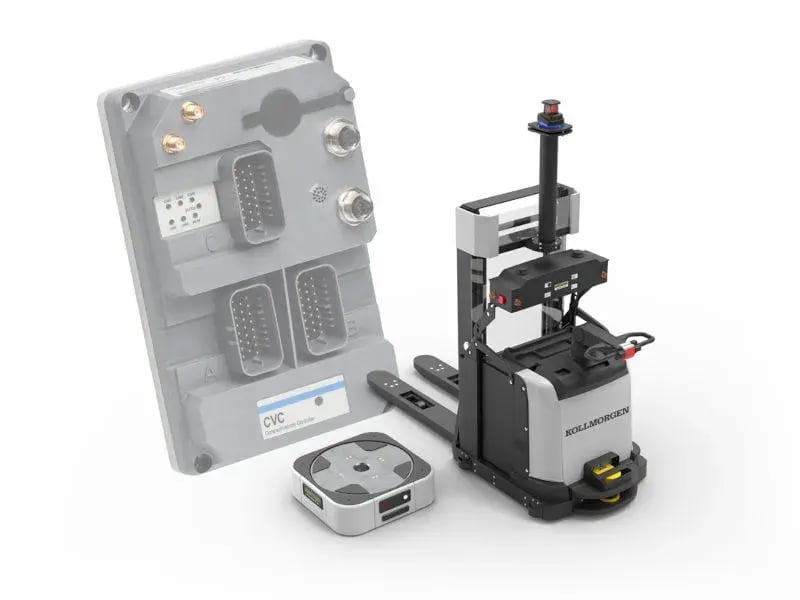
Kollmorgen CVC700 vehicle controller
2. Natural navigation and positioning systems
Reflectors and floor tape are giving way to navigation that reads the building itself. BlueBotics, a ZAPI GROUP company, builds ANT lite+ as a combined vehicle control and positioning system for AGVs, automated forklifts, and mobile robots. It localises to within ±1 cm and ±1 degree using natural features and works with safety laser scanners from SICK, OMRON, Leuze, and HOKUYO. The hardware is an embedded industrial computer drawing under 20 W.
3. Traction and pump motor controllers
Every AMR needs to accelerate, steer, brake, and lift. Curtis Instruments' 1232E is an AC induction motor controller for traction and hydraulic pump duty, with models from 175 A to 250 A output at 24 to 80 V system voltages. It's CANopen-compatible, sealed to IP65, and CE-marked as a programmable safety device under EN ISO 13849-1, achieving Performance Level d for uncommanded powered movement. Power electronics and functional safety in one box is a demanding build.
Seeing and staying safe: Sensing and safety
4. Safety laser scanners
A driverless truck in a shared aisle has to stop for people every time, while a compact, certified, and optically aware combination is a hard one to manufacture repeatably. SICK's nanoScan3 is a safety laser scanner just 80 mm tall, with a three-metre protective field and a 275-degree scanning angle. It's rated SIL2 to IEC 61508 and Performance Level d to EN ISO 13849, and SICK positions it for mobile intralogistics, cobots, and autonomous transport platforms.
5. 3D perception and obstacle detection
Two-dimensional scanners see a slice of the world. Pallet forks, overhanging loads, and low obstacles need more. The ifm O3R perception platform connects up to six 3D time-of-flight camera heads to a central unit built around an NVIDIA processor, which processes images on the vehicle. It's a distributed system of several optical assemblies, cabling, and a compute unit that all have to work together.
6. Safety controllers
Scanners detect, but it’s something else that has to decide. Pilz's PNOZmulti 2 is a configurable safe small controller with motion monitoring, used on driverless vehicles to supervise axes and switch protective fields as speed and direction change. Pilz positions its intralogistics offering around ISO 3691-4, the safety standard for driverless industrial trucks and their systems, which shapes the hardware design from day one.
Keeping it running: power and connectivity
7. Wireless charging systems
A robot that stops to plug in is a robot that isn't working. Wiferion, now a PULS brand, builds the etaLINK 3000, an inductive charger delivering 3 kW at up to 93% efficiency. It charges across a 15 to 40 mm gap with ±30 mm positional tolerance and offers IP65 and IP68 protection. Robots can top up opportunistically during short stops rather than leaving the floor entirely.
8. Industrial wireless communication
Fleets depend on the network as much as the robot. Siemens' SCALANCE WUM766-1 is an industrial Wi-Fi 6 client module, launched in 2021, with up to 1.2 Gbps gross transmission rate. Siemens built it for fast roaming between access points without service interruption, with features for redundant wireless delivery to moving vehicles and a sleep mode to save energy across AGV fleets. A dropped connection mid-aisle can stop a whole fleet, so the radio is mission-critical.
The human and data layer: interfaces, inspection, and monitoring
9. Industrial touch terminals
Zebra's VC8300 is a vehicle-mounted computer with an 8-inch, 1,000-nit touchscreen, a 10-inch variant, and an operating range of -30 to +50 degrees Celsius. Internal heaters, controlled by smart temperature sensors, keep the display and electronics warm in freezer environments, and the unit is sealed to IP66. A terminal that works at -30 is a long way from an office tablet, but people are still able to do the job.
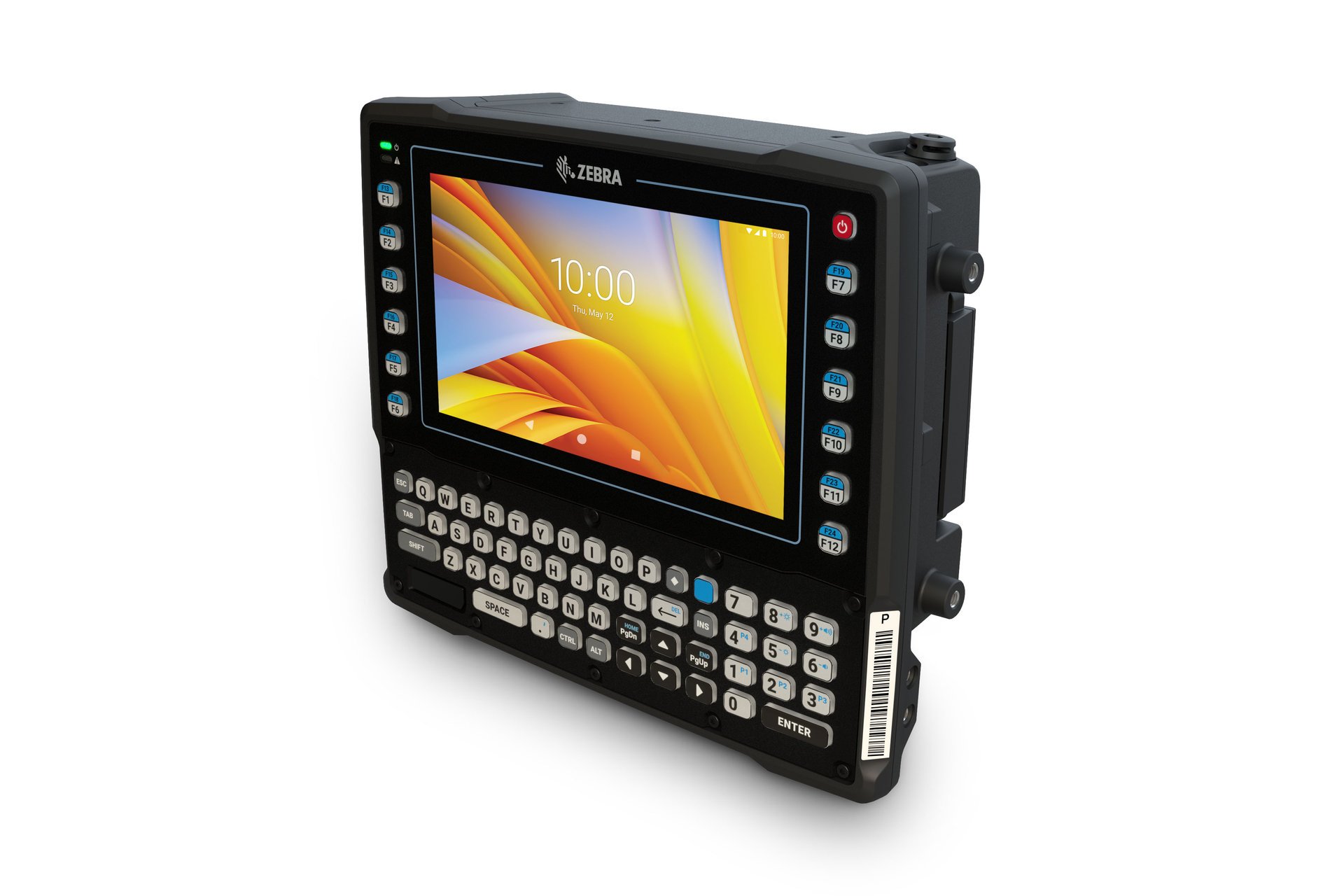
Zebra VC8300 vehicle-mounted computer
10. Vision inspection and barcode reading
Every parcel and tote has to be identified at speed. Cognex's DataMan 380 series fixed-mount barcode readers run up to 16.13 megapixels, and the 380 Modular Vision Tunnel combines them in configurations from a single overhead reader to a six-sided system. Cognex aims the tunnel at logistics, e-commerce, retail, and baggage handling. Optics, illumination, and image processing make this precision electronics, not just a camera on a bracket.
11. RFID readers
Where barcodes need line of sight, RFID doesn't. Impinj's R700 is a fixed RAIN RFID reader with four antenna ports, up to 1,100 reads per second, and Power over Ethernet. It runs a dual-core ARM processor with Linux, so tag-processing applications can run on the reader itself, and it operates from -20 to +50 degrees Celsius. Readers like this sit at dock doors, conveyors, and robot pick points.
12. Environmental sensors
Cold chain and pharmaceutical warehouses have to prove their conditions, not just control them. Vaisala's VaiNet RFL100 is a wireless temperature and humidity data logger for warehouses, cold storage, freezers, and GxP-regulated environments. It communicates over more than 100 m indoors without repeaters and runs for up to 18 months on standard AA batteries. Low-power, reliable radio and calibrated measurement in one small device is a careful balance, but one that this sensor achieves.
What warehouse automation hardware has in common
These products aren't consumer electronics, but medium-volume, high-mix assemblies that combine electronics with mechanics, optics, and power, and they have to keep working on vehicles that run around the clock.
Safety is their first constraint. ISO 3691-4:2023 sets out requirements for driverless industrial trucks, including AGVs and AMRs, and the EU Machinery Regulation (EU) 2023/1230 applies from 20 January 2027, with autonomous mobile machinery among the technologies it was intended to cover. For an OEM, that means traceable builds, controlled processes, and test records that will stand up to a conformity assessment.
The environment is the second. Vibration, impact, battery-level power swings, freezer temperatures, and constant duty cycles put weight on ruggedisation decisions made at the design stage, on sealing and connector choice, and on thermal design around power electronics.
Lifecycle is the third constraint consideration. A warehouse fleet bought today will still need spares and repairs years from now, which makes component obsolescence planning a design decision rather than a purchasing one.
That combination favours mechatronics and electromechanical assembly over bare board supply. A vehicle controller, a charging station, or a perception unit arrives as a finished, tested system, and the integration is where most of the risk sits.
ESCATEC’s transportation electronics manufacturing work includes logistics and warehouse automation, as well as road, rail, aviation, and maritime. Our vertically integrated capability across design and development, printed circuit board assembly, box build, mechatronics, machining, plastic injection moulding, and test solutions means a product can move from prototype to volume without changing partners.
Conclusion
Warehouse automation isn't one technology. It's a dozen interlocking hardware systems, each with its own safety case, environmental brief, and service life, arriving in a mobile robot market forecast to nearly triple by 2030. For OEMs building into that market, the constraint is rarely the robot concept. It's whether the controllers, sensors, drives, and chargers inside it can be certified, built repeatably, and supported across a fleet's working life.
If you're developing AGV, AMR, or warehouse automation hardware, talk to our team about the design and manufacturing decisions that decide how it performs on the warehouse floor.

FAQs
1. What hardware is inside an AGV or AMR?
A typical AGV or AMR combines a vehicle controller, a navigation and positioning system, traction and pump motor controllers, safety laser scanners, 3D perception cameras, a safety controller, a battery and charging system, and an industrial wireless module. The wider warehouse adds an industrial touch with terminals, vision inspection, barcode readers, RFID readers, and environmental sensors.
2. What is the difference between an AGV and an AMR?
An AGV follows fixed or predefined routes, traditionally guided by wires, magnetic tape, or reflectors. An AMR navigates autonomously using onboard sensors and maps, planning its own path and moving around obstacles. Both are covered by ISO 3691-4:2023 as driverless industrial trucks.
3. Which safety standards apply to AGVs and AMRs?
ISO 3691-4:2023 specifies safety requirements and verification for driverless industrial trucks and their systems, including AGVs and AMRs. In the EU, the Machinery Regulation (EU) 2023/1230 applies from 20 January 2027, replacing the Machinery Directive. Components such as safety laser scanners and motor controllers are typically rated to EN ISO 13849-1 or IEC 61508.


