


This list highlights eight incumbents and disruptors who are building the next generation of controls, sensors, gateways, analytics, or security solutions.
Building automation companies matter more now than ever
Building automation companies design, manufacture, and support systems that monitor, control, and optimise building services such as HVAC, lighting, access, safety, and energy.
They matter more than ever now because buildings are under intense pressure. Driven by energy volatility, ESG scrutiny, and new expectations for work and living spaces, smart building investment is being pushed to new heights, with the global smart buildings market projected to grow at a CAGR of 24.4% to reach USD 827.7 billion by 2034.
In parallel, BACnet Secure Connect, multi‑protocol IoT devices, and AI‑driven analytics are turning traditional BAS into data platforms that feed digital twins, grid‑interactive demand response, and automated compliance reporting.
OEMs in the smart building ecosystem must provide hardware and firmware that can operate within these environments. This list of eight leading building automation companies to watch focuses on those that have real-world scale, open integration paths, and visible momentum.
Eight leading building automation companies to watch
1. Johnson Controls: OpenBlue & Metasys
Johnson Controls is a global BAS heavyweight, with Metasys as its core BMS and OpenBlue as the cloud platform that layers analytics, energy optimisation, and services across building portfolios. OpenBlue Enterprise Manager pulls in data from HVAC, lighting, security, and external sources, such as tariffs and weather, to unlock double-digit energy and maintenance savings in large estates.
For OEMs, Johnson Controls is a reference for AI‑enabled BAS. In 2024, it brought generative AI into OpenBlue to accelerate diagnostics and optimise setpoints automatically. Devices that can expose rich, well‑tagged BACnet data and secure connectivity will be far easier to integrate into OpenBlue‑driven projects and portfolio energy programmes.

Johnson Controls OpenBlue cloud BMS
2. Siemens Smart Infrastructure: Desigo CC & Building X
Siemens’ Desigo CC provides unified control of HVAC, fire safety and security, with deep BACnet support and native cloud connectivity in recent versions. Building X then sits above as a suite of cloud applications for energy, space and asset management, enabling cross‑portfolio optimisation and remote operations.
The company has been an early adopter of BACnet/SC to harden BAS networks and align with IT security practices. For OEMs, this means that Desigo/Building X projects increasingly require secure, IP-native devices with modern object models and consistent tagging—especially if your product is intended for critical infrastructure or regulated sectors.
3. Schneider Electric: EcoStruxure Building Operation
EcoStruxure Building Operation (EBO) is Schneider Electric’s flagship BMS, covering HVAC, power, lighting and access across complex buildings and campuses. Its servers and workstations are BACnet-certified, enabling mixed-vendor BAS topologies while still providing operators with a single pane of glass for control and analytics.
Schneider’s SpaceLogic KNX BMS IP Gateway is worth noting: it acts as both BACnet Application Specific Controller and KNX gateway, certified by BTL and designed to pull KNX room devices into EBO‑based projects, with significant installation time savings. If you have, or plan to develop, KNX-based products, ensuring clean interoperability with this gateway can open doors in Schneider-standardised portfolios.
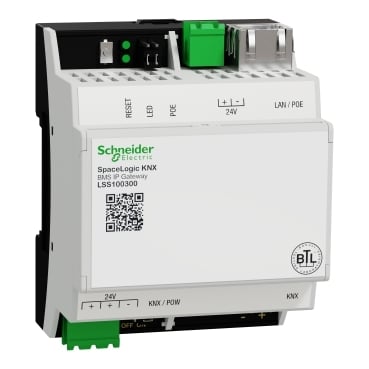
Schneider SpaceLogic KNX BMS IP Gateway
4. Honeywell Building Technologies: Honeywell Forge for Buildings
Honeywell Building Technologies combines traditional BMS offerings with Honeywell Forge, a cloud platform that aggregates OT data to deliver energy analytics, FDD, and portfolio benchmarking for large estates. Forge is hardware‑agnostic, integrating with existing BMS and field devices to create a unified view of asset performance and risk.
In 2024, Honeywell announced a partnership with Google to connect Forge’s industrial and building data with Gemini generative AI, aiming to cut design time and drive more autonomous operations. This means devices should be designed with secure cloud connectivity and rich telemetry, so AI can perform useful work like optimising schedules, auto-drafting documentation, or helping engineers triage alarms.
5. ABB: ABB Cylon & i‑bus KNX
ABB’s building automation range spans ABB Cylon, focused on HVAC and energy management for commercial and industrial buildings, and ABB i‑bus KNX, its KNX‑based platform for controlling lighting, blinds, heating and more. Together, they cover everything from plant room controls to room‑level comfort in offices and multi‑dwelling buildings.
ABB is important because it anchors many KNX-focused projects and is investing in energy-efficient KNX devices that align with ESG objectives. If you’re an OEM building KNX sensors, actuators or gateways, making life easy for ABB‑centric integrators—through certification, clear documentation, and robust support—can dramatically increase your odds of specification.
6. Automated Logic: WebCTRL Building Automation System
Automated Logic’s WebCTRL is a web‑based BAS platform built around BACnet, popular in campuses and complex commercial buildings. It offers intuitive visualisation, advanced scheduling, and built-in FDD, with fully BACnet-interoperable controllers that integrate well with third-party devices.
Recent releases have emphasised secure networking and BACnet/SC, including new OptiFlex integration routers and network isolators that segment BAS traffic across IP, MS/TP, and ARCNET.
For OEMs, WebCTRL is a good benchmark for what “enterprise‑ready BACnet” looks like; BTL listing and BACnet/SC support will make it far easier to be considered in WebCTRL‑driven designs.
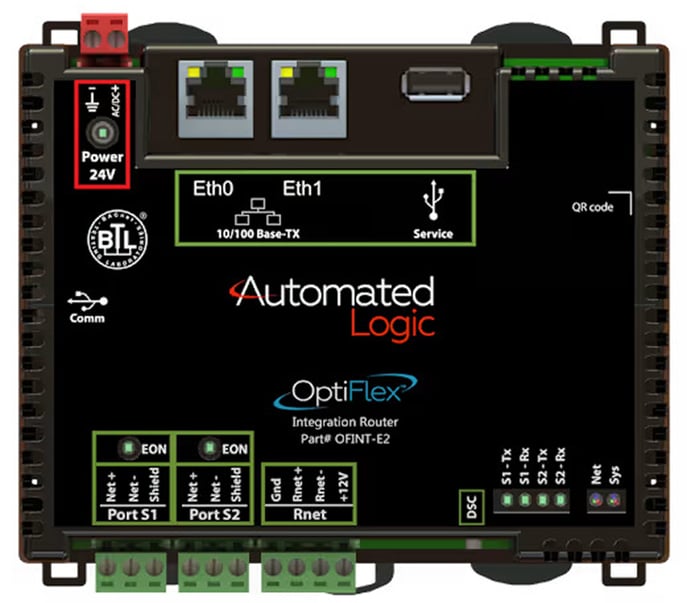
Automated Logic OptiFlex BAS integration router
7. Distech Controls: ECLYPSE & ENVYSION
Distech Controls (Acuity Brands) is known for IP‑native controllers and browser‑based tools that feel at home in IT environments. The ECLYPSE series of BACnet/IP and Wi‑Fi HVAC controllers, combined with ENVYSION visualisation, deliver flexible control and responsive UIs for HVAC, lighting and shade control.
ECLYPSE showcases where room and plant controllers are heading: secure, IP‑native devices, configured via modern web interfaces and able to participate in IoT ecosystems. Designing your own modules, gateways or sensors with similar assumptions (TLS, modern APIs, remote updates) can help ensure they won’t feel out of place in future-forward deployments.
8. BrainBox AI: AI HVAC Optimisation & Cloud BMS
BrainBox AI specialises in overlay AI for HVAC optimisation. Its solution connects to existing BMS/BAS via BACnet gateways, the Niagara framework, cloud-connected thermostats, or cloud-to-cloud APIs, learning each building’s thermal behaviour and then adjusting HVAC operation every few minutes using weather, tariff, and occupancy data.
In 2025, Trane Technologies acquired BrainBox AI and launched the BrainBox AI Lab to accelerate autonomous and generative AI-based building decarbonisation solutions. This acquisition suggests that AI overlays that respect existing BAS investments are gaining traction quickly. If your HVAC equipment and sensors can share high‑quality data with such platforms, you’re more likely to ride that wave than be bypassed by it.
How building automation OEMs benefit from partnering with ESCATEC
Behind every smart building platform or sensor is a physical product that must be designed, certified, manufactured, and supported at scale. ESCATEC acts as an end‑to‑end EMS partner for OEMs, supporting product design, DfX, prototyping, NPI, test strategy, regulatory readiness, and scalable manufacturing for OEMs in smart building and adjacent sectors.
Quality leaders want robust quality systems, clear traceability, and regular audits that actually improve the process, not just tick boxes. Procurement directors seek stable OTIF, credible supply chain risk management, and a partner that can scale with growth.
At the same time, engineering leaders need fast‑turn prototypes, peer‑to‑peer collaboration, and DFM/DFT support so they can recover schedule without compromising design intent. Board‑level sponsors and operations managers care about total cost, resilience, and whether the factory footprint can keep up with demand and ESG commitments. Product managers want broader portfolios and faster time‑to‑market without blowing up internal headcount.
ESCATEC aligns with all stakeholders to co-develop smart building devices that are designed for manufacturability, certified to relevant standards, and ready for integration; whether they be BACnet/SC controllers, KNX or Matter‑enabled devices, or edge AI modules feeding digital twins.
Conclusion
Building automation companies are evolving fast, blending classic BAS/BMS with cloud, edge AI and OT security. For OEMs, the bar is now set by platforms that are open, standards‑based and demonstrably secure, aligning with what owners, integrators, and investors already expect.
If you’re planning your next building automation product, ESCATEC can support you from concept through to stable series production.
Download our smart buildings guide for more insights, or talk to our team about how we can help you de‑risk the journey.

FAQs
How do BMS and BAS differ?
In practice, “building management system” (BMS) and “building automation system” (BAS) are often used interchangeably. Many vendors use BMS for the supervisory software and BAS for the overall stack (supervisory layer plus controllers and devices), but for OEMs the key is how easily your products integrate, from BACnet or KNX through to cloud APIs.
Which standards matter most for OEMs in smart buildings?
BACnet (including BACnet/SC), KNX, and Modbus remain core standards in commercial buildings, while Matter, Zigbee/Thread, and LoRaWAN are increasingly influential for IoT-style devices and retrofits. Supporting at least two of these ecosystems—and providing robust, well‑documented APIs—can significantly expand your addressable market.
How can OEMs accelerate time‑to‑market for smart building devices?
The most effective levers are building on proven software frameworks, integrating early with target BAS platforms, and partnering with an EMS that understands complex, connected products. Knowledgeable EMS partners who understand the ecosystem, like ESCATEC, can cut development and industrialisation timelines dramatically.