




In this guest Q&A, Akhil Oltikar, co-founder and CEO of Omnics, shares his perspective on the challenges shaping electronics manufacturing today. He discusses how EMS companies can strengthen visibility, improve planning accuracy, and use technology to make faster, more informed supply chain decisions.
What are the biggest supply chain challenges currently facing electronics manufacturers, and how can advanced planning tools like Omnics help address them?
One of the biggest challenges in electronics manufacturing right now is that the entire environment has become more dynamic than ever before. The only ‘Constant’ in today’s supply chains is ‘Change’. You’ve got volatility in component availability, suppliers pushing out lead times without warning, and critical parts like semiconductors that are still seeing demand-supply mismatches long after the pandemic-era shocks.
The reality is, even a small change in a customer forecast or one delayed component can ripple across multiple builds and weeks of production — and many manufacturers are still trying to manage that with spreadsheets, emails, and tribal knowledge.
From our experience at Omnics, the real pain points come down to a few core things:
- Lack of real-time visibility into what can be built today versus what’s stuck due to material gaps
- Inability to simulate or model “what-if” scenarios — like if a customer changes their demand mix or a key supplier misses a PO delivery
- And difficulty making safety stock or inventory decisions without understanding the tradeoffs across customers or products
Where advanced planning tools like Omnics really help is by connecting the dots across demand, supply, and operations in real time. For example, our platform helps EMS and OEMs run multi-level clear-to-build checks, simulate changes instantly, and identify material bottlenecks before they become missed shipments. It’s about turning static planning into dynamic, constraint-aware decision-making.
At the end of the day, the question is: can you answer, with confidence, “what can I build this week, and what’s at risk?” If the answer isn’t clear, that’s where tools like Omnics come in.
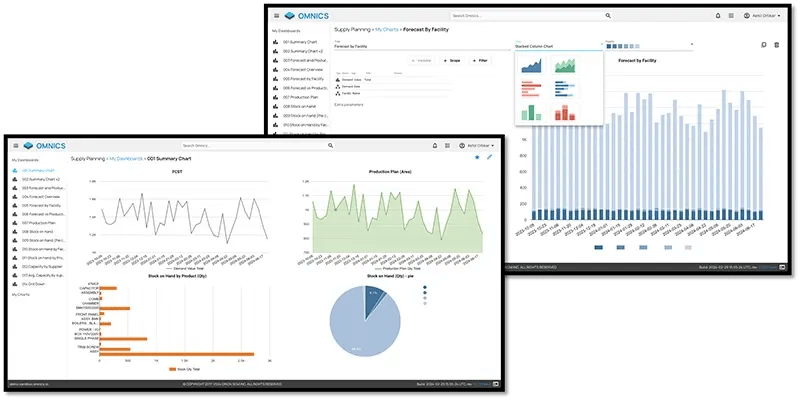
Omnics dashboards
How do demand forecasting errors uniquely impact EMS players compared to other manufacturing sectors?
Forecast errors hurt everyone, but they hit EMS providers especially hard, because they’re managing other people’s demand, not their own.
In captive manufacturing, if your forecast is off, you might lose sales or carry excess inventory, but at least you control the full equation: customer relationship, production, fulfillment, margin. In EMS, you are operating on thin margins, often building to customer-provided forecasts or upside commits, and you are expected to absorb the variability when those forecasts go sideways.
There are two major ways forecast errors impact EMS companies:
1. Over-forecasting leads to E&O risk.
You order parts, sometimes with long lead times, based on a customer’s forecast, and if they reduce or shift demand, you’re stuck with components that might never be used again. These can’t always be returned, and customers don’t always reimburse you. That hits your balance sheet directly as excess and obsolete inventory, and it’s one of the biggest killers of EMS profitability.
2. Under-forecasting leads to missed revenue and customer escalations.
On the flip side, if the customer under-forecasts or drops in a last-minute upside, and you don’t have enough components or capacity, you miss shipments. That doesn’t just cost revenue, it damages trust, triggers expedite costs, and disrupts the entire build schedule across customers.
The bottom line is: EMS businesses are caught in the middle, expected to be flexible without having true control over demand. That’s why forecast stability analysis, demand reconciliation, and what-if planning are so critical. EMS companies need to understand proactively and quickly how stable is the forecast, what parts are at risk, and how do I protect margin while still being responsive? Data and information fluidity plays a critical role in answering these questions.
In your view, what role does visibility across tiers (suppliers, sub-suppliers) play in EMS success, and how can technology support that?
Visibility across tiers, especially upstream tier 2 and tier 3, is becoming absolutely essential for EMS companies to operate with any degree of predictability.
Historically, EMS players have had decent visibility into their direct supplier, they know which distributor or broker they bought the part from. But where that part actually came from, how stable that upstream supply is, whether that part is single-sourced or at risk, that’s usually a blind spot.
That blind spot matters because in EMS, you don’t get months of notice when something breaks upstream. We find out when the line is supposed to run and the part’s not there, and by then it’s already a customer escalation.
The most critical visibility gaps I see are:
- Tier-2 component status for semiconductors, passives, custom parts — especially for long lead items
- PO commit visibility (will the part arrive as promised, or has the ETA quietly slipped?)
- Alternates and substitute options that are approved or already used elsewhere
- Shared component risk across customers or products that isn’t flagged until it causes a conflict
Technology helps by aggregating data across systems and suppliers, not just ERP data, but emails, spreadsheets, PDFs from suppliers, and surfacing insights in real time. That’s something we’ve focused on heavily at Omnics: by onboarding your suppliers we make the upstream risk visible before it becomes a stopper.
You don’t need perfect traceability for every part. But you do need to know what’s at risk, what’s late, and what you can do about it — before the customer finds out.
How can EMS manufacturers balance agility and cost efficiency in their supply / inventory planning?
This is probably one of the hardest balancing acts for EMS companies, and the truth is, there’s no single right answer. You're constantly walking the line between being responsive to customer demand and not blowing up your working capital with excess inventory.
On one hand, customers expect agility, short lead times, upside flexibility, last-minute changes. On the other hand, components have long and inconsistent lead times, and carrying too much inventory exposes EMS providers to E&O risk, especially with high mix and short product life cycles.
Here’s how I see EMS manufacturers navigating that balance more effectively:
Move beyond static safety stock rules.
Fixed min/max levels or safety stock formulas based on past usage just don’t work anymore.
You need dynamic buffers that adjust based on current forecast volatility, supplier reliability, and lead time risk. Some components deserve buffer, others don’t.
Make material availability part of the planning conversation, not an afterthought.
Many EMS teams build schedules assuming material will arrive on time. That’s wishful thinking. The smartest EMS players now simulate builds based on real-time clear-to-build logic and use that to adjust production plans and customer commits. That’s how you stay agile and avoid overpromising.
Tie inventory strategy to customer segmentation.
Not all customers or products are equal. Some are strategic, some are transactional. The buffer you hold, the priority you assign, the expedite you approve, it all must be linked to customer value and risk, not just part number logic.
Coordinate across sites without duplicating inventory.
If you’ve got multiple sites, you don’t want every plant stocking the same parts just to feel safe. Having shared visibility into global inventory, supply pipeline, and demand alignment is key. That’s where multi-site simulation and risk pooling becomes really powerful.
Use technology to make this practical.
Honestly, none of this is feasible with spreadsheets alone. You need tools that can simulate demand, supply, and inventory in real time, not in hindsight.
What key metrics should EMS companies track to assess the effectiveness of their supply chain planning systems?
For EMS companies, it's not enough to just “run the plan”, you’ve got to measure whether your planning system is actually improving the business. And that starts with tracking the right metrics, ones that tie directly to cost, service, and operational risk.
Here are the core ones I recommend EMS companies monitor closely:
CTB realization rate
“Of what was planned to be built, how much was actually started and completed as planned?”
- This is the ultimate supply-execution KPI.
- Measures how often material availability, demand shifts, or capacity constraints disrupted planned builds.
- Low CTB realization means your planning process and system is not grounded in real constraints.
Commit accuracy (to customer requests)
“How accurate were our build/delivery commits vs what actually shipped?”
- EMS firms make rolling promises to customers based on planned supply and capacity.
- This metric tracks the gap between commitment and execution.
- A strong planning system should minimize reschedules and broken promises.
Forecast accuracy & forecast error (by customer and product family)
“How stable and reliable are the demand signals you're planning to?”
Since EMS companies don’t own the forecast, they need tools to measure its volatility and error rate, and build buffer or risk strategies accordingly.
Inventory turns & excess/obsolete inventory (E&O)
“Is inventory being consumed efficiently, or sitting idle?”
This is especially critical in high-mix EMS where stale inventory ties up working capital. You want to track:
- Turns by site/customer
- Slow-moving part count
- $ value of E&O (ideally flagged before it becomes E&O)
Working capital impact from supply planning decisions
“What is your supply plan costing you in terms of tied-up cash?”
A good planning system should not just aim for service, it should balance inventory investment, supplier commitments, and cash exposure.
Order cycle time & reschedule volatility
“Are builds and deliveries flowing through the system smoothly?”
Track how often build dates are slipping, being rescheduled, or needing expedite. That volatility is often caused by poor supply-demand synchronization, and is a cost driver (expedites, labor, customer dissatisfaction).
Planner efficiency / cycle time for decision support
“How long does it take to go from demand/supply change to an informed, confident decision?”
- This is a proxy for whether your planning system is helping humans do their jobs better, not just producing dashboards.
- Should be measured in hours, not days, especially for high-impact exceptions.
The goal is to turn these metrics into a closed-loop feedback system, where planners, program managers, and execs can not only see what’s working, but where to intervene before cost or service issues snowball.
How important is scenario planning / simulation in handling disruptions (e.g. component shortages, trade barriers, logistics delays)?
Scenario planning isn’t a luxury anymore, it’s a requirement. Especially in EMS and electronics manufacturing, where a single part shortage or upstream delay can block millions of dollars of product, the ability to simulate "what happens if..." is how you stay ahead of risk instead of just reacting to it.
We’ve seen this play out time and again. Let me give you a real example.
One of our customers, an EMS provider supporting a high-growth consumer electronics brand, was hit with a sudden delay on a custom part due to a sub-tier fab shutdown overseas. The lead time slipped by 5+ weeks. Without fast visibility into the impact, they were facing multiple line stoppages and a potential customer escalation.
Within hours, using Omnics, they ran three critical simulations:
1. What customer orders would be impacted by the shortage?
They saw $3.2M of revenue at risk in the next 3 weeks across 4 product SKUs.
2. What alternate builds could still proceed using available inventory?
They identified 2 products that shared ~80% of the same BOM but didn’t depend on the delayed part. They immediately shifted those forward in the production schedule.
3. What happens if they expedite a partial shipment from the supplier at a premium?
They ran a cost-benefit simulation and found that paying the expedite fee would protect ~70% of the at-risk revenue and avoid downstream penalty costs.
Those simulations turned into real decisions, fast. They re-allocated line time, prioritized builds, approved the expedite, and proactively notified the customer of one delayed SKU with options.
No surprises. No firefighting.
That’s the value of scenario planning, it turns chaos into structured options and engages the parties in data-driven discussions. You’re still facing disruption, but now you’ve got a plan and a decision framework to respond intelligently.
What are the biggest pitfalls that EMS firms encounter when implementing a unified supply chain planning platform?
The concept of a “unified planning platform” sounds great on paper, but EMS companies often run into very real roadblocks when they try to implement one. The biggest pitfalls usually fall into four categories, and they all have more to do with people and process than just the software.
Data integration fatigue: too many sources, not enough trust
Most EMS firms are running on a patchwork of “Systems of Record” (ERP, PLM, MES etc.), spreadsheets, shared drives, supplier emails, and tribal knowledge. Trying to unify all of that into a single planning layer exposes how broken and inconsistent the data really is. So even when the integration is technically “done,” users still don’t trust the data, so they keep falling back to Excel.
Lack of process discipline
EMS teams are execution machines, they’re built to react fast, not to run long planning cycles. So when you try to roll out S&OP or forecast reconciliation without first establishing basic process discipline, it falls apart. The planning tool ends up with stale forecasts, outdated CTB views, or mismatched POs, and no one wants to own the data updates or exception resolution. You can’t automate chaos.
Cross-functional misalignment, no clear owner of “the plan”
In EMS, the demand comes from customers, the data lives in supply chain, and the pressure lands on operations. Without strong cross-functional governance, every group sees the planning platform as someone else’s responsibility. You need clear ownership: Who owns the demand signal? Who approves changes? Who communicates with the customer? Otherwise, planning becomes reporting, not decision-making.
Trying to do everything at once
Some firms try to boil the ocean: unify all sites, customers, and products in one go. That rarely works. The smarter approach is to start with one high-impact use case (like CTB or E&O risk) and prove value. Then you earn the right to scale.
Technology is a powerful enabler, but in EMS, it only works when it’s layered on top of real process ownership, data trust, and organizational alignment. At Omnics, we focus not just on installing the software, but embedding discipline that sticks.
How do you see emerging technologies (AI / ML, digital twins, IoT) influencing the future of supply chain planning in electronics manufacturing?
There’s a lot of noise around emerging tech in supply chain — and while the buzzwords come and go, the reality is that electronics manufacturers need practical, focused applications of AI and digital tools that solve everyday chaos. That’s where I think the real breakthroughs will happen.
Here’s how I see it breaking down:
AI/ML: Best when focused on pattern recognition, not magic forecasts
Everyone wants to believe AI can fix demand forecasting — but in EMS, you’re still forecasting other people’s demand. The real value of AI in EMS is:
- Detecting forecast instability: flagging which customers or SKUs are volatile so planners can apply buffers or prioritize reviews.
- Predicting material risk: spotting part shortages or late deliveries before they appear in CTB.
- Identifying early signals of E&O: using historical patterns to flag inventory that’s likely to become obsolete.
ML shines when it’s used to augment human judgment, not replace it.
Digital twins: Powerful when tied to real decisions
Digital twin is a buzzword, but when you strip it down, it just means: “simulate your real supply chain with live data and constraints.” For EMS, the most powerful use of digital twins is:
- Simulating CTB or build plan changes across sites, customers, and parts
- Evaluating trade-offs: revenue impact, capacity impact, inventory risk
- Testing new customer onboarding or product ramps before committing to supply or line time
What makes this useful is real-time data and planning logic behind the twin, not a pretty visualization. When done right, it becomes your sandbox for strategic and operational decisions.
The real breakthrough isn’t just the tech, it’s making it usable inside a chaotic EMS environment, where speed, trust, and actionability matter more than elegance.
How can smaller or mid-sized EMS providers compete with large OEMs in terms of supply chain sophistication?
“It’s not the big that eats the small – it’s the fast that eats the slow”. Smaller EMS firms may not have the scale or budgets of Tier 1 players, but that doesn’t mean they can’t match, or even beat, them in planning agility, responsiveness, and customer service. In fact, smaller players often have an edge because they can move faster, adopt tools more easily, and don’t have legacy systems slowing them down.
Here are the best practices I’ve seen smaller EMS providers use to punch above their weight in supply chain sophistication:
Build a “tactical control tower”, not a big-bang platform
You don’t need a $10M enterprise suite to improve visibility. Start with a focused, modular tool that helps answer real questions, provide basic visibility and simple but powerful what-if scenario planning
Run scenario planning like a Tier 1, but faster
Large OEMs often take weeks to model scenarios across the network. Smaller EMS players can run what-if simulations on the fly: “What if this shipment is late? What if demand shifts?”, and make decisions in hours, not weeks.
Responsiveness is a competitive advantage. The faster you can pivot, the more confidence customers will place in you, even over bigger vendors.
Segment customers and parts for smart buffering
You don’t have to buffer everything. Use simple segmentation to define:
- Strategic customers vs. transactional ones
- High-risk components vs. stable parts
This helps smaller EMS providers protect service levels without blowing up inventory: a major source of margin erosion in mid-sized operations.
Use cross-functional S&OP to align fast
While larger companies may have elaborate S&OP cycles, smaller EMS firms can run leaner, monthly (or even bi-weekly) reviews to align customer demand, material risk, and operations.
This is where finance, supply chain, and customer teams get on the same page, and it’s more about discipline than complexity.
Turn supplier and customer relationships into a superpower
Smaller EMS firms can create stronger, more agile partnerships — with faster decision cycles and better collaboration. Use that to your advantage:
- Loop in key suppliers on shortages or expedite needs
- Proactively share CTB or material risk data with customers
- Be the vendor that communicates early, not the one explaining delays
Supply chain sophistication isn’t about having the most tech, it’s about using the right tech, with the right process, at the right time. Mid-sized EMS firms can absolutely compete if they focus on visibility, speed, and scenario-based decision making.
Q: What advice would you give EMS companies to future-proof their supply chains over the next 5–10 years?
If there’s one thing the last few years have taught us, it’s that EMS supply chains need to be built for change, not just cost. Over the next 5–10 years, the winners will be the ones that shift from pure efficiency to resilience, responsiveness, and data-driven execution.
Here’s my advice to EMS leaders looking to future-proof their operations:
Build planning systems that flex, not break, under change
You can’t control customer demand or global supply volatility. But you can control how fast you see it and how quickly you respond. That means investing in agile planning infrastructure; systems that can simulate disruptions, reallocate supply, and re-prioritize builds without weeks of manual work.
Treat data like a supply chain asset
Data is no longer a reporting tool, it’s a differentiating asset. But only if it's clean, connected, and real-time. EMS companies need to stop tolerating fragmented spreadsheets and tribal knowledge. Future-proofing means building a unified data architecture: shared demand signals, multi-tier visibility, and connected BOMs and supplier data across sites.
Design for multi-tier visibility and risk modeling
Most EMS providers only see their tier-1 suppliers. That’s no longer enough. Future-ready EMS supply chains need visibility into tier-2 and tier-3, alternate sourcing strategies, and risk scores for critical parts. The next disruption won’t send a calendar invite — you need to model “what breaks where” in advance.
Sustainability will shift from optional to operational
More OEMs will push sustainability down the chain: carbon footprint reporting, responsible sourcing, and scrappage reduction will become baked into contracts. EMS companies that can model material utilization, optimize packaging and logistics, and reduce excess through smarter planning will stand out.
Don’t wait to standardize cross-site planning processes
If you’re managing supply chain by site, you're already behind. The future is multi-site, centralized visibility with local flexibility. That means standard S&OP cadence, shared planning assumptions, and scalable tooling, even across small and mid-sized plants.
You don’t need to invest like a Tier 1 OEM to future-proof your supply chain. But you do need to think like one: invest in data, process discipline, flexible systems, and a planning mindset that prioritizes adaptability over perfection. That’s what we’re helping our customers build with Omnics.
About Omnics
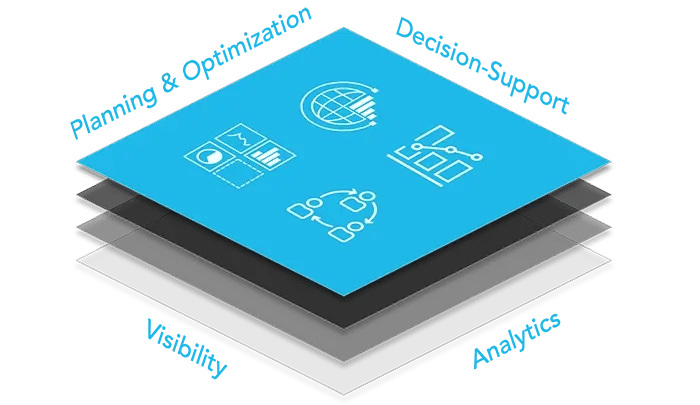
Omnics.io is a Saas platform for supply chain planning and operations that uses AI to help companies manage data, plan and optimize their supply chains, and make better decisions.
It provides tools for demand forecasting, supply and inventory planning, and visibility to replace traditional spreadsheets. The platform is designed to work across multiple industries and helps businesses improve efficiency, resilience, and performance.
🔗 If you missed our previous feature on Omnics and their partnership with ESCATEC, you can read it here
Visit www.omnics.io to learn more about the services they offer.


